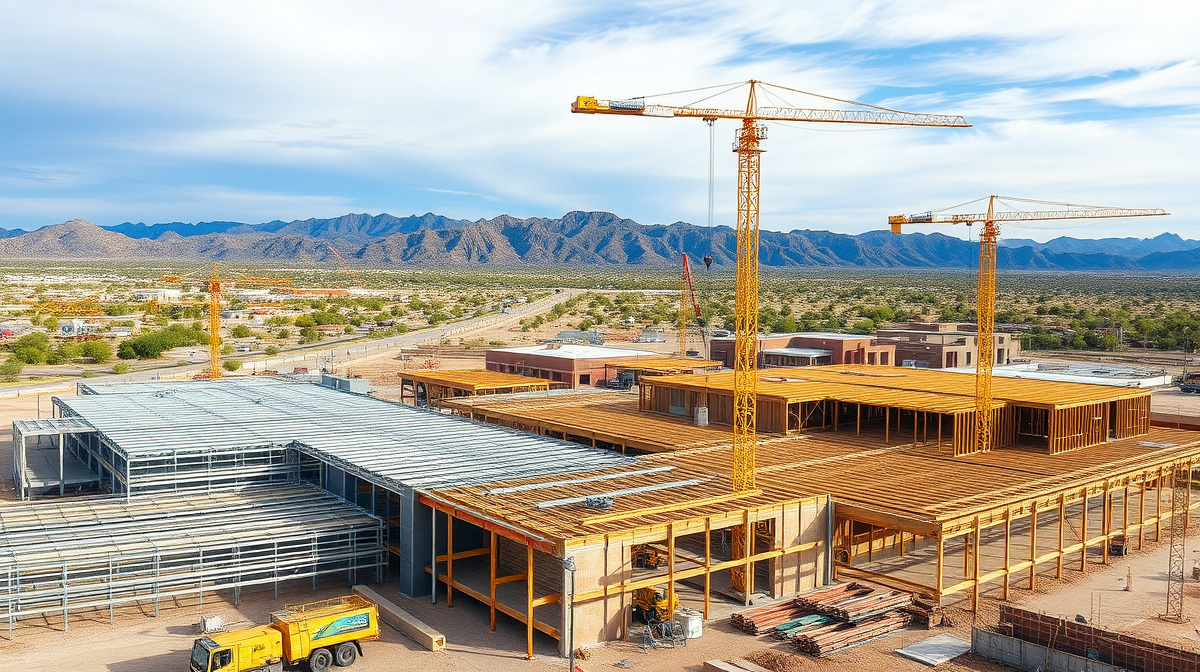
Most conversations about Arizona's construction boom default to Phoenix — the semiconductor fabs, the hyperscale data centers, the warehouse buildout stretching across the East Valley. That story is real, but it isn't the whole state, and it isn't Tucson's story. Pima County is running its own industrial and commercial construction cycle right now, driven by different projects, different tenants, and a genuinely tightening industrial real-estate market — and it deserves to be understood on its own terms, not as a footnote to Phoenix.
For building owners, developers, and general contractors working in or near Tucson, that distinction matters for a practical reason: a construction boom this scale translates directly into demand for building envelope performance, not just square footage under roof. Here's what's actually happening in Pima County right now, and what it means for anyone building, buying, or operating a commercial or industrial building in the region.
The Scale of Tucson & Pima County's Current Industrial Pipeline
Start with the numbers, because they're large enough to change how the region gets talked about. American Battery Factory is building a $1.2 billion, 2-million-square-foot LFP battery gigafactory at the Aerospace Research Campus — reported as the largest LFP battery cell manufacturing facility in the country. Becton Dickinson has committed $65 million to a new Tucson-area manufacturing facility. And a proposed $3.6 billion data center development in southeast Tucson has cleared its first Pima County approval and moved through City of Tucson review — a project that, if it proceeds at that scale, could be one of the largest economic-development projects in the region's history.
Those are anchor projects, but they're not the only signal. A six-party memorandum of understanding among Southern Arizona institutions is advancing collaboration around semiconductor, optics, and photonics manufacturing in the region — the kind of institutional coordination that tends to precede, not follow, further industrial investment.
Meanwhile the speculative side of the market has been unusually active. Tucson metro industrial vacancy fell from roughly 16% in 2024 to about 8% in 2025 after a wave of speculative building deliveries — a sign that developers were confident enough in demand to build ahead of signed tenants, and that the market absorbed it. Nearly 900,000 square feet of speculative industrial space is completing in the Airport and Northwest submarkets alone, including projects like Butterfield Logistics Center (about 194,879 sq ft), Corona Commerce Center (about 146,963 sq ft), and Drexel Commerce Center (about 191,252 sq ft). New supply is projected to push vacancy back up through 2026 — which reads less as a slowdown and more as a market still actively building.
| American Battery Factory gigafactory | $1.2B investment, 2M sq ft, Aerospace Research Campus — largest LFP battery cell facility in the U.S. |
|---|---|
| Becton Dickinson manufacturing facility | $65M committed to a new Tucson-area facility |
| Proposed southeast Tucson data center | $3.6B proposed development, cleared initial Pima County approval and City of Tucson review |
| Industrial vacancy trend | ~16% (2024) → ~8% (2025), with new speculative supply projected to lift vacancy back up through 2026 |
| Speculative industrial deliveries | ~900,000 sq ft completing in Airport/Northwest submarkets (Butterfield Logistics Center, Corona Commerce Center, Drexel Commerce Center) |
Figures reflect research current as of this article's publish date — verify current project status before citing in a formal proposal.
Why This Growth Means Real Demand for Envelope Performance, Not Just Floor Space
A gigafactory, a data center, and a wave of speculative distribution buildings are very different building types, but they share one thing: none of them can afford a building envelope that's an afterthought. Battery manufacturing and semiconductor-adjacent facilities run process equipment sensitive to temperature swings. Data centers run enormous, continuous cooling loads where every improvement in envelope performance translates directly into lower mechanical operating cost. And speculative warehouse and distribution buildings — the kind leasing up across the Airport and Northwest submarkets — compete for tenants partly on operating cost, where an insulated, properly sealed envelope is a real differentiator against an older, uninsulated building down the road.
In other words, this isn't a boom in floor space alone — it's a boom in buildings that need to perform, because the tenants moving into them are running expensive equipment, expensive cooling loads, or expensive inventory, and can't treat the envelope as a commodity. That's a meaningfully different conversation than "how many square feet can we get under roof the fastest," and it's the conversation Pima County's current construction cycle is actually having.
Pima County's Code Environment and TEP's Commercial Programs
Tucson and the rest of Pima County sit in IECC Climate Zone 2B — the same numeric hot-dry zone as Phoenix, not a distinct hot-humid or cold zone, which matters for envelope spec decisions on any project crossing between the two metros. Arizona is a home-rule state with no single mandatory statewide energy code, and Pima County has been working through its own code adoption process — as of this research, the county was moving through consideration of the 2024 IECC, a more current cycle than the 2018 IECC baseline most Arizona jurisdictions still use. Anyone bidding or permitting a commercial project in the county should confirm the currently adopted code version at time of permit, since that adoption status evolves.
On the utility side, Tucson Electric Power's Business Energy Solutions program offers prescriptive and custom commercial incentives for Pima County businesses — covering HVAC, envelope-adjacent measures, and other efficiency upgrades, with custom incentives reported around 75% of incremental equipment or measure cost under program documentation (confirm current caps and terms directly with TEP, since custom-incentive terms change more often than flat rebate programs). For a building owner weighing envelope upgrades against a tightening industrial market, that program is a real lever most single-city, residential-focused contractors never bring up because they simply don't work in TEP's territory.
Why Tucson Has Been an Underserved Market for Commercial Spray Foam
Here's the part of this story that's specific to how the spray foam insulation industry itself is structured in Arizona: most dedicated spray foam contractors in the state are small, single-region operations built around homeowner attic and wall retrofits in one metro — usually Phoenix. Tucson and Pima County, despite running an industrial and commercial construction cycle with billion-dollar anchor projects, have not had a contractor whose core business is built around commercial and industrial envelope work in this specific market.
That's a gap, not an oversight. A production home builder's residential retrofit crew isn't equipped — or, often, licensed and staffed — to bid a gigafactory-scale manufacturing shell, a data-center cooling envelope, or a 190,000-square-foot speculative distribution building. Those projects need a contractor who thinks in whole-building envelope packages, works from architectural and mechanical plan sets, coordinates with GC trade sequencing across multi-month schedules, and understands Pima County's specific code and utility-incentive landscape — not a contractor whose default frame of reference is a single-family home's attic.
That's the market this company exists to serve in Tucson and Pima County: not a satellite service area tacked onto a Phoenix-based book of business, but a genuine commercial and industrial presence in a region that's earned one.
What This Means If You're Building, Buying, or Operating in Pima County Right Now
- If you're a developer or GC bidding a new industrial or commercial shell in the region, envelope performance should be part of the pro forma from the plan-review stage, not a change order after the building is dried in.
- If you're a facility owner evaluating an existing warehouse, distribution, or light-industrial building in a tightening vacancy market, envelope condition — insulation, air sealing, roof performance — is a real lever on operating cost and competitiveness against newer speculative product.
- If you're tracking TEP's commercial incentive programs or Pima County's evolving code adoption, that's a conversation worth having with a contractor who actually works in this county regularly, not one quoting from a Phoenix-centric playbook.
Ready to Talk About a Tucson-Area Project?
Whether it's a metal building, a warehouse shell, a cold-storage facility, or an envelope package tied to one of the region's larger industrial developments, we work Pima County as a core market — not a special trip. See our full statewide service areas page for how Tucson fits into our broader Arizona service footprint, or go straight to a Tucson-specific bid request.