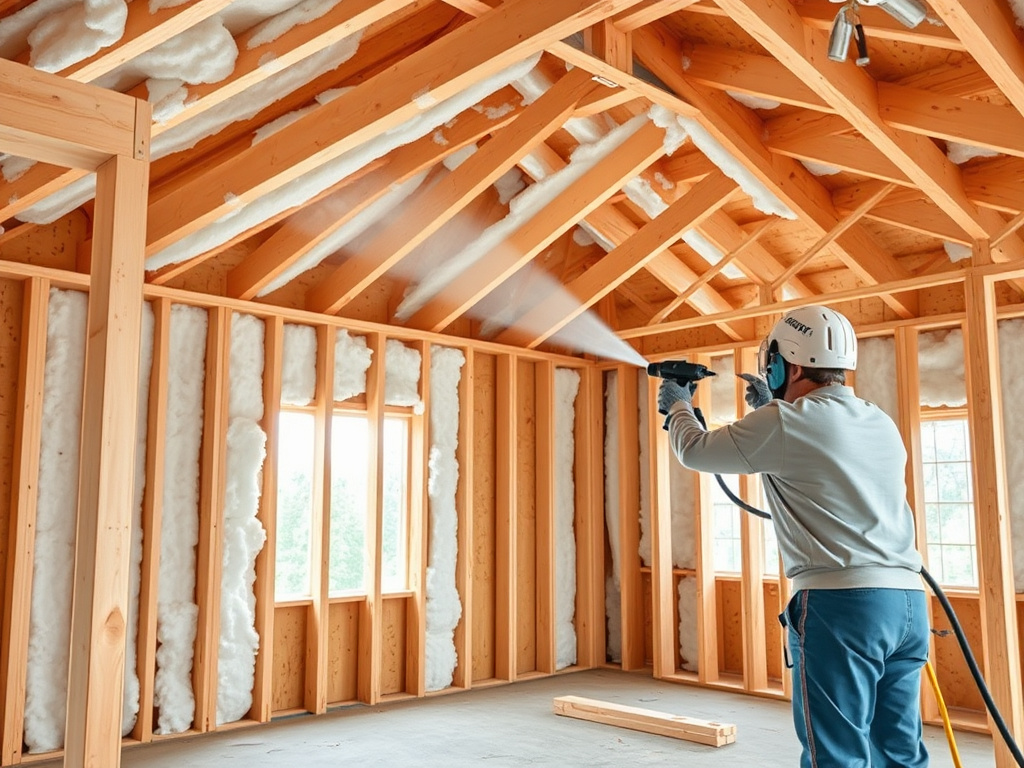
Residential New Construction
Residential New-Construction Spray Foam — A Builder-Partnership Service, Not a Retrofit
This page is about partnering with production builders, custom-home builders, and developers on new residential construction statewide — not homeowner attic retrofits. If you're a builder or developer looking for a consistent envelope partner across your active communities, this is that service.
What This Page Is — And Isn't
A builder-partnership service for new residential construction
This service exists for one purpose: partnering with production home builders, custom-home builders, and residential developers on new residential construction, statewide. It is not a homeowner retrofit offer, it is not an attic comparison-shop page, and it doesn't lead anywhere near DIY or existing-home re-insulation content. If you're a homeowner looking to insulate or re-insulate an existing house, this isn't the right page — our capacity here is committed to builder and developer relationships.
If you're a builder, general contractor, or developer bringing homes out of the ground — production communities, custom one-off builds, or master-planned residential phases — this is exactly the service line built around how your schedule, your trades, and your spec sheets actually work.
Why Builders Choose Us
Why builders bring in a statewide commercial-grade contractor for residential work
Most residential insulation subs are set up for a single crew working a handful of houses in one metro. Our operation was built around commercial and industrial work first — metal buildings, warehouses, and cold-storage facilities — which means the process discipline that comes with that (documentation, batch records, standing schedules, multi-site coordination) carries directly into residential work rather than being bolted on as an afterthought. For the full picture of how that commercial-first build philosophy plays out across every service line, see our commercial & industrial spray foam insulation guide.
- ✓Consistent spec quality across multiple active communities, not crew-to-crew variation
- ✓Standing pricing for repeat, ongoing project relationships instead of re-bidding every house
- ✓One point of contact across job sites statewide — Phoenix metro, Tucson, high country, and everywhere between
- ✓Documentation and batch records delivered the same way on every house, every phase
Climate-Zone Specs
Whole-envelope specs by Arizona climate zone
A builder working in only one part of Arizona can standardize on a single assembly and never think about it again. A builder developing across more than one region can't — the low desert and the high country genuinely need different envelope specs, and a spec sheet written for one doesn't transfer cleanly to the other.
Zone 2B covers Phoenix, Tucson, and Yuma — hot-dry, extreme-cooling-load territory where the envelope's job is almost entirely about keeping heat out and conditioned air in. Zone 3B covers the Santa Cruz County/border region, with a milder but still dry profile. Move up in elevation and the load profile shifts meaningfully: Zone 4B covers Prescott and Sedona-elevation communities, and Zone 5B covers Flagstaff, Coconino County, and the White Mountains/Navajo County high country, where winter heat retention becomes as important as summer cooling.
For a production or custom builder working communities in more than one of these zones — a common pattern for master-planned developers with both Valley and high-country projects — we spec each community against its actual climate zone rather than applying one Phoenix-only assembly statewide.
| Zone 2B | Phoenix, Tucson, Yuma — hot-dry, cooling-load dominant |
|---|---|
| Zone 3B | Santa Cruz County / border region — warm-dry |
| Zone 4B | Prescott / Sedona-elevation communities |
| Zone 5B | Flagstaff, Coconino County, White Mountains high country |
Directional framing by zone — final assembly always follows a plan review against the jurisdiction's adopted residential code.
Mechanical Coordination
HVAC right-sizing conversations builders can bring to their trade partners
Foam applied at framing stage seals the envelope before drywall closes it up, which changes the load calculation your mechanical trade partner is working from. A sealed, consistent envelope generally supports a smaller, better-matched HVAC system than a standard batt-insulated house built to the same square footage — a real first-cost lever in value engineering, not just a comfort upgrade.
We hand over sealed-envelope data your mechanical trade partner can use directly in a Manual J calculation for each home plan, so equipment sizing reflects how the house will actually perform rather than a generic assumption baked into a standard plan set. For builders running the same floor plans across dozens of homes in a community, getting this right once, at the plan level, pays off across every house built from that plan.
Code Coordination
One partner across coordinated commercial-and-residential build programs
Developers running master-planned projects often have single-family, multifamily, and commercial components moving through the same jurisdiction's permitting process at once — a residential subdivision phase alongside an amenity building, a clubhouse, or a ground-floor commercial component. Each piece follows its own applicable code path, and residential work is typically evaluated under the jurisdiction's adopted residential energy-code path rather than the commercial provisions that govern the rest of the project.
Because we work commercial, industrial, multifamily, and residential new construction under one operation, a developer running a mixed-use master plan gets one insulation partner tracking every applicable code path across the entire project — instead of coordinating a residential sub separately from whoever handles the commercial and multifamily components. For the commercial and multifamily side of a mixed project, see our multi-family & mixed-use construction insulation service page.
Scheduling At Scale
Repeat-community and phased-subdivision scheduling
Production communities don't release all at once — they move in phases, with new lots starting framing while earlier phases are already through drywall. That rhythm only works if the insulation sub shows up on a standing schedule rather than getting re-quoted and re-booked house by house.
We set up priority sequencing across a builder's active communities so crews move from house to house on the same cadence your framers and MEP trades are already working to, with standing pricing that doesn't require a new bid cycle every time a new phase releases. For a builder or developer running several active communities at once, that single standing relationship is often the deciding factor over a smaller local sub who can only reliably cover one site at a time — the same logic that underpins our new-construction spray foam service for builders and general contractors.
ADU & Casita Packages
ADU, casita, and guest-house packages within larger projects
Accessory dwelling units, casitas, and guest houses are increasingly part of both production-community plan sets and custom master-planned residential projects across Arizona. These smaller structures still need a full envelope spec — including termite-inspection gap requirements at grade for exterior foam applications — and they're usually built on the same site timeline as the primary residence rather than as a separate, later project.
We package ADU and casita insulation into the same scheduling and pricing relationship as the primary home build, so a builder isn't managing a second sub or a second bid cycle for a structure that's really just an extension of the same job site.
Builder-Partnership Context
One factual note on federal residential incentives
Briefly, and only in the context of what builders should and shouldn't tell buyers: the federal Section 25C tax credit for residential energy-efficiency improvements already expired for any insulation work completed after December 31, 2025. Builders should not market 25C-eligibility to buyers on homes completing in 2026 or later — the credit no longer applies to that work. This isn't this site's incentive story (that's the commercial Section 179D deduction covered on our energy code compliance & audits page), just a factual point worth having straight before it comes up with a buyer.
4
AZ climate zones spanned (2B–5B)
1
Point of contact, statewide
12/31/25
Residential 25C already expired
0
Retrofit or DIY jobs — new construction only
Common Questions
Builder-partnership questions
Do you insulate existing homes, or only new construction?
+
This service is exclusively for new residential construction — production communities, custom homes, and developer-built projects at framing stage. We don't do attic retrofits, re-insulation of existing homes, or homeowner-initiated comparison-shop jobs. If a homeowner reaches out about an existing house, we refer them elsewhere; our residential capacity is committed to builder and developer partnerships.
Why would a builder use a commercial-grade contractor instead of a standard residential insulation sub?
+
Consistency across job sites. A builder running multiple active communities needs the same spec, the same documentation, and the same point of contact on every house, whether it's in Buckeye or Prescott Valley. We built our crews, scheduling systems, and documentation standards around commercial and industrial work first, which is a different level of process discipline than a typical single-crew residential sub carries into a production environment.
How does the envelope spec change between low-desert and high-country communities?
+
Materially. A Phoenix or Tucson community sitting in Zone 2B has different insulation and vapor-control needs than a Prescott or Flagstaff community in Zone 4B or 5B. A builder developing in more than one part of the state needs a spec sheet that flexes by project location rather than a single Phoenix-only assembly applied everywhere — that's exactly the kind of cross-zone consistency we're set up to deliver.
Can you keep up with a phased subdivision release schedule?
+
That's the core of how we're built to work. Production communities release homes in phases, not all at once, and we schedule priority sequencing across a builder's active communities rather than treating each house as a one-off job that has to be re-quoted and re-scheduled from scratch.
Is the residential 25C tax credit something we should be telling buyers about?
+
No — and this is worth flagging directly. The federal Section 25C credit for residential energy-efficiency improvements already expired for any insulation work completed after December 31, 2025. Builders should not market 25C-eligibility to buyers for homes completing in 2026 or later; it no longer applies. This is a minor, factual point in the context of our builder partnerships, not a program we build into any project's pitch.
Start a builder-partnership conversation
Tell us about your community, custom project, or master-planned development — plan set, phase schedule, and locations — and we'll scope a standing relationship, not a one-off bid.