Commercial Roofing
Commercial Roof Spray Foam (SPF Roofing) Systems Across Arizona
A seamless, fully adhered foam-and-coating roof system built for flat and low-slope commercial and industrial buildings — engineered to correct drainage, not just cover it up, and priced per square foot like the rest of the commercial roofing market.
The System
What SPF roofing actually is
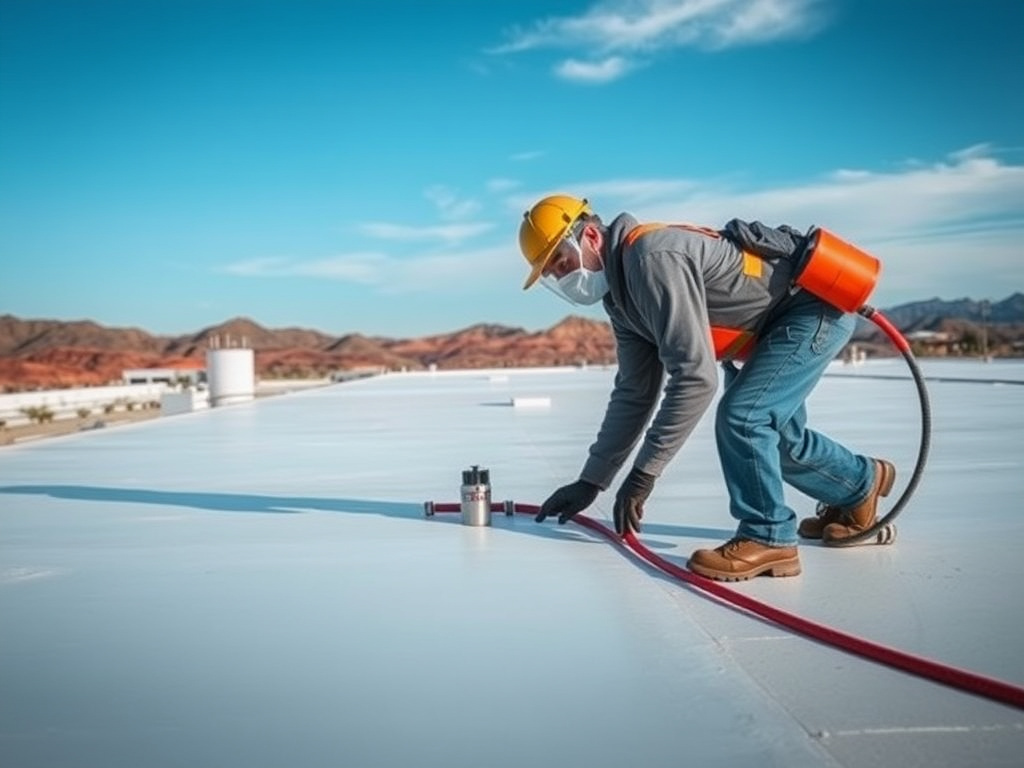
Spray polyurethane foam (SPF) roofing is a two-component liquid foam that's spray-applied directly onto a flat or low-slope commercial roof deck or existing roof surface, where it expands and cures into a rigid, closed-cell insulating substrate. Once cured, the foam is covered with a protective elastomeric coating — typically silicone or acrylic — that handles UV exposure, weathering, and reflectivity while the foam underneath carries the insulation value.
The result is a monolithic, fully adhered roof membrane with no seams, laps, or fasteners penetrating the surface — a fundamentally different assembly than a built-up, modified bitumen, or single-ply roof, all of which rely on seamed sheets or sections joined together. For facility owners and general contractors managing commercial and industrial roofs across Arizona's heat and UV load, that seamless construction is the whole point.
- ✓Spray-applied closed-cell foam substrate, built to the thickness the roof needs
- ✓Protective elastomeric coating (silicone or acrylic) for UV, weathering, and reflectivity
- ✓Fully adhered, monolithic membrane — no seams, laps, or exposed fasteners
- ✓Installs over most existing low-slope commercial roof types after inspection
Why It Fits Arizona
No seams to fail under Arizona's UV and thermal cycling
Arizona's low-slope commercial roofs take a harder beating than most of the country's: intense UV exposure, roof-surface temperatures that swing 80-plus degrees between a summer night and midday sun, and long stretches with no rain to wash accumulated grit off a membrane. Seamed roofing systems fail predictably at their seams — laps open, fasteners back out, flashing details separate from field membrane — because every joint is a place for thermal movement to concentrate stress.
SPF roofing doesn't have that failure point. Because the foam is sprayed in place and bonds directly and continuously to the substrate and to itself at every transition, penetration, and edge detail, there's no lap or fastener line for thermal cycling to work against over years of Arizona heat. The foam carries the insulation value; the coating on top carries the UV and weathering duty and can be specified in a reflective ("cool roof") finish to cut rooftop heat gain further — a meaningful factor on any building where cooling is the dominant operating cost.
0
Seams In The Membrane
15-20 Yr
Typical Recoat Cycle
$6-$12+
Per Sq Ft Installed (Directional)
AZ
Statewide Service
New Roof vs. Recover
Recover over an existing roof, or a full tear-off
Most SPF roofing projects on existing commercial buildings are recover jobs — the foam-and-coating system is applied directly over sound existing roofing after it's cleaned, inspected, and prepared, without demolishing what's already there. That's a real cost and schedule advantage over a tear-off, and it's why SPF is a common choice for facility owners looking to extend a roof's life without a full replacement project.
Tear-off becomes the right call when an existing roof has saturated insulation, structural deck issues, multiple failed roof layers already stacked from prior recovers, or moisture trapped where it can't dry out. We assess this with a site walk and, where the roof history is unclear, a core cut or infrared/moisture scan — not a guess from the ground. New-construction roofs are a third scenario entirely: SPF applied directly to a new deck as the primary roofing and insulation system from day one, coordinated with the roofing trade sequence on a new build.
Drainage
Slope-to-drain design corrects ponding, not just conceals it
Ponding water is one of the most common and most damaging problems on flat commercial roofs — it accelerates membrane breakdown, adds structural dead load, and voids most conventional roof warranties outright. Because SPF is applied as a liquid that's built up in controlled passes, a qualified crew can vary the foam thickness across the roof deck — adding more foam at low spots and tapering it down toward drains and scuppers — to build genuine positive slope into a roof that has none.
That's a structural correction to how water moves off the roof, not a cosmetic fix layered on top of standing water. Board-and-batt insulation systems and most conventional membranes can't do this without a separate tapered insulation package and a full roof rebuild; SPF builds the drainage correction into the same install that provides the insulation and weatherproofing.
Lifecycle Cost
A maintained roof, not a one-time sale
The foam substrate in a properly installed SPF roof is a long-lived material, but the system's working life is managed through its coating. Industry-standard practice calls for a recoat cycle in the 15-20 year range, with the exact interval depending on coating type, UV exposure, rooftop foot traffic, and equipment penetrations — plus lighter interim maintenance (recaulking penetrations, spot-repairing traffic wear near mechanical units, clearing drains) in the years between full recoats.
For a facility owner or property manager, that's a genuinely different conversation than a conventional roof replacement sold as a single fixed-life product. We frame SPF roofing as a lifecycle-cost decision from the start: what a recoat cycle costs against what a full tear-off-and-replace cycle costs over the same span, and how a planned maintenance recoat compares to an unplanned leak repair and the downtime that comes with it. That's the conversation we have on the site walk, before a bid is written — not an upsell after the fact.
Pricing
Priced per square foot installed — a different convention than wall or attic work
Wall and attic spray foam work is typically priced per board foot — a function of material volume sprayed into a cavity. Commercial roofing doesn't work that way. Like the rest of the commercial roofing industry, SPF roofing is priced per square foot of roof area installed, with the rate driven by substrate condition, whether the project is a recover or a tear-off, the foam thickness and slope-to-drain design required, the coating system specified, and the density of rooftop equipment, penetrations, and flashing detail.
Industry-standard installed pricing for commercial and industrial SPF roofing generally falls in the $6-$12+ per square foot range. That figure is directional — useful for early budget planning — not a quote. Every project gets a site walk (or plan review, for new construction) before we scope a number, because roof condition, deck type, and drainage design move that range more than almost anything else.
| Pricing basis | Per square foot of roof area installed |
|---|---|
| Directional range | $6-$12+ per sq ft, subject to a site walk and bid |
| Recover vs. tear-off | Determined by substrate condition, not assumed |
| Typical recoat cycle | 15-20 years, verified against manufacturer spec |
Directional, industry-standard figures for early planning — not a fixed quote. Final pricing follows a site walk or plan review.
Code & Warranty
Code and warranty basics for facility owners
Commercial roof assemblies in Arizona are reviewed against wind-uplift and fire-rating requirements set by the applicable building code and the specific jurisdiction's adopted edition — part of the same jurisdiction-by-jurisdiction patchwork that shapes commercial energy-code compliance statewide. SPF roof systems are specified and installed to the foam and coating manufacturer's tested assemblies, which carry documented wind-uplift and fire-rating classifications we can provide to your design team or code official as part of the project package.
Warranty terms on a commercial SPF roof are issued by the manufacturer of the specific foam-and-coating system installed, typically for a defined term against water intrusion when the system is installed and maintained to spec — including the recoat interval discussed above. We'll walk through the specific manufacturer warranty terms, what maintenance is required to keep it in force, and how it compares to a conventional built-up or single-ply roof warranty as part of every bid.
One more note for facility owners planning ahead: the federal Section 179D commercial building energy-efficiency tax deduction is closing to any project whose construction begins after June 30, 2026, under the One Big Beautiful Bill Act. Because most SPF roofing work is a recover or retrofit on an existing building rather than new construction, 179D eligibility depends heavily on project scope and timing and shouldn't be assumed — that's a conversation for your tax professional and, on the technical side, our Energy Code Compliance & Commercial Energy Audits team.
Related Services
Often specified alongside a roof project
SPF roofing addresses the roof deck. Many of our commercial and industrial clients pair it with interior envelope work on the same building.
Commercial & Warehouse Building Insulation
Envelope insulation for warehouses and commercial buildings, often scoped together with a roof project on the same site.
Explore this service →Metal Building & Pre-Engineered Structure Insulation
Interior condensation and thermal control for pre-engineered metal buildings — often bid alongside a spray foam roof retrofit.
Explore this service →FAQ
Commercial SPF roofing questions
Can SPF roofing go over our existing commercial roof, or do we always need a tear-off?
+
In most cases SPF roofing installs as a recover system directly over an existing roof — built-up, modified bitumen, single-ply, even some metal roof decks — once the substrate is inspected for structural soundness and moisture. Tear-off becomes necessary when there's saturated insulation, structural damage, or so much existing roof buildup that adding another layer isn't sound. We make that call after a site walk and, where needed, a core cut or moisture scan, not from a photo.
How long does a commercial SPF roof actually last before it needs attention?
+
The foam itself is a long-lived material, but the system's service life is really managed through its protective coating. Industry-standard practice is a recoat cycle in the 15-20 year range, with a lighter maintenance recoat or spot repair possible sooner depending on UV exposure, foot traffic, and rooftop equipment penetrations. We build a maintenance recommendation into every project so facility owners can budget for it as a planned lifecycle cost rather than a surprise.
Does spray foam roofing actually fix ponding water, or does it just cover it up?
+
Done correctly, it fixes it. Because SPF is spray-applied in a liquid state and rises as it cures, a qualified crew can build in additional thickness at low points and taper it toward drains and scuppers, creating true positive slope where none existed. That's a structural correction to drainage, not a cosmetic patch — and it's one of the few commercial roofing methods that can do it without adding tapered insulation board or reworking the deck.
What does commercial SPF roofing cost per square foot in Arizona?
+
Industry-standard installed pricing for commercial and industrial SPF roofing typically runs in the $6-$12+ per square foot range, depending on existing substrate condition, whether it's a recover or a tear-off, foam thickness and slope-to-drain design, coating system selected, and rooftop equipment complexity. That figure is directional, not a quote — every project gets a site walk and a scoped bid before we put a number on it.
What kind of warranty comes with a commercial SPF roof system?
+
Warranty terms are set by the coating and foam manufacturer whose system we install, and they typically cover the membrane against water intrusion for a defined term when the system is installed and maintained per spec. We'll walk you through the specific manufacturer's warranty terms, required maintenance/recoat intervals to keep it in force, and how that compares to conventional built-up or single-ply roof warranties as part of the bid.
More questions? Visit the full FAQ page or read the commercial & industrial spray foam guide.
Get a scoped bid for your commercial roof
Send us your roof's location, size, and current condition and we'll schedule a site walk and come back with a real bid — not a ballpark. Call 844-967-5247 or request a bid online.