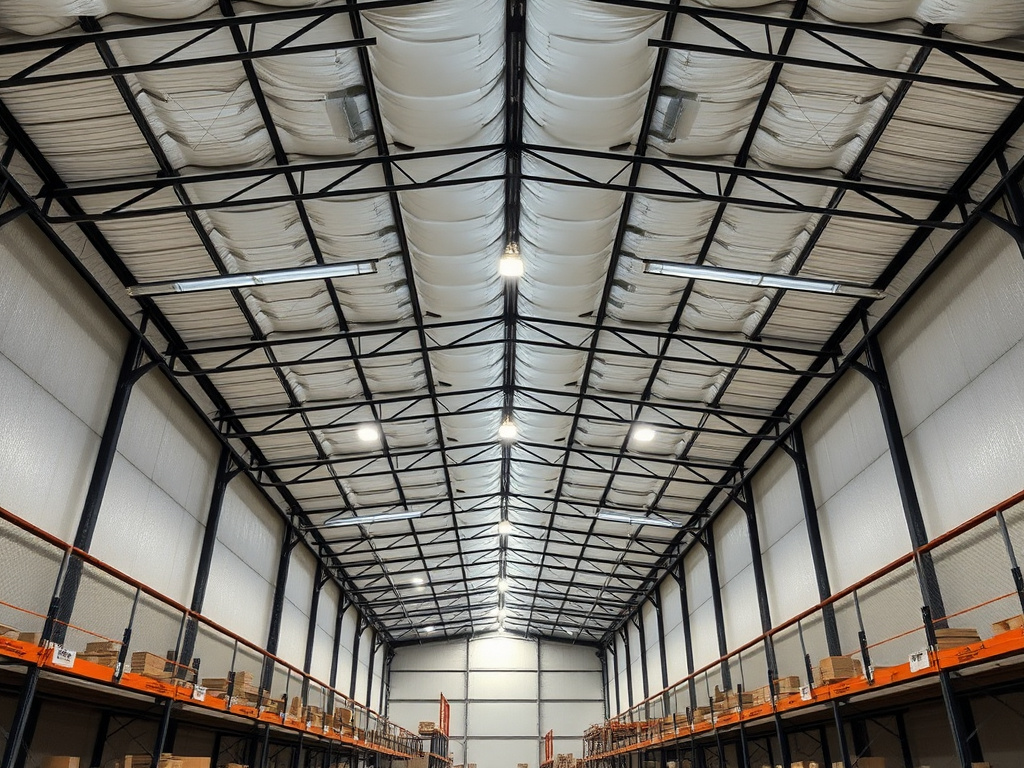
Commercial & Industrial Buildings
Commercial & Warehouse Building Insulation Across Arizona
Envelope insulation for warehouses, distribution centers, and commercial shells across Arizona's statewide logistics and industrial build-out — closed-cell and open-cell systems specified to the actual building type, not one generic assembly.
Who We Serve
Built for Warehouses, Distribution, and Commercial Shells — Not One Building Type
Warehouses and distribution centers, light-industrial shops and flex space, office and retail shell buildouts, and self-storage facilities each present a different envelope problem — a warehouse roof deck versus an office shell's exterior wall versus a self-storage building's run of small, individually conditioned or unconditioned units. But the underlying decision that drives every one of those projects — closed-cell or open-cell, and how much of the building actually needs to be conditioned — follows the same logic from project to project. We scope each building on its own terms rather than forcing every job through one template.
Statewide Industrial Growth
Arizona's Industrial Build-Out Makes the Envelope a Real Operating-Cost Line Item
Arizona's commercial and industrial construction pipeline is a statewide story, not a single-metro one. The Phoenix corridor's semiconductor and hyperscale data-center wave — anchored by TSMC's Phoenix campus and its multi-fab build-out — has pulled a wave of warehouse and logistics construction along with it: Arizona's manufacturing construction starts rose roughly 84% year-over-year in 2025, and office/data-center construction starts rose about 111% over the same period. Tucson and Pima County have their own separate industrial story: industrial vacancy fell from roughly 16% in 2024 to about 8% in 2025 after a wave of speculative deliveries, with close to 900,000 square feet of new speculative industrial space completing in the Airport/Northwest submarkets alone, alongside gigafactory-scale manufacturing investment and a large proposed data-center development working through county and city review.
84%
AZ Manufacturing Construction Starts, YoY 2025
111%
AZ Office/Data-Center Construction Starts, YoY
16%→8%
Tucson Industrial Vacancy, 2024 to 2025
~900K sf
Speculative Industrial Space, Tucson Submarkets
For an owner or operator, that pipeline means a warehouse or distribution building's cooling and refrigeration load is a bigger, more visible operating-cost line than it was a decade ago. Envelope performance stopped being an afterthought the moment that much new industrial square footage started coming online at once, statewide.
Assembly Selection
Matching the Foam System to the Shell
Tilt-up concrete and block/CMU shells hold real thermal mass but still need a continuous air and vapor control layer at penetrations and roof-to-wall transitions — closed-cell spray foam adds a high-R, low-permeance layer directly to the interior face without relying on a separate membrane that can be punctured during racking installation or later tenant-improvement work. Metal-skin pre-engineered buildings have a different problem entirely: an exposed metal interior surface that will condense moisture directly onto a cooled or conditioned space unless something breaks the thermal bridge at every purlin and girt — closed-cell foam sprayed direct-to-metal is the standard fix. Open-cell has a role too, mainly at interior partitions and ceiling assemblies where acoustic dampening between conditioned office space and warehouse floor matters more than vapor control.
- ✓Tilt-up / concrete shells: closed-cell at penetrations and roof-to-wall transitions for continuous air control
- ✓Block/CMU shells: closed-cell added to the interior face for R-value the masonry alone doesn't provide
- ✓Metal-skin pre-engineered buildings: closed-cell direct-to-metal to stop condensation at purlins and girts
- ✓Interior partitions and office/warehouse divides: open-cell for acoustic dampening where vapor control isn't the driving concern
Operating Cost
AC and Refrigeration Are the Operating Cost in an Arizona Warehouse
In Arizona's climate, cooling — and, for a growing number of facilities, refrigeration — is the dominant utility-cost driver in a warehouse or distribution building, not heating. An uninsulated or under-insulated metal or tilt-up shell means the HVAC or refrigeration system is fighting a continuous heat gain through the roof deck and walls all summer, every summer, on top of whatever load the racking, lighting, and equipment inside already puts on it. A properly insulated envelope doesn't replace mechanical equipment, but it changes what that equipment has to fight against — the same right-sizing logic builders and general contractors apply on the new-construction side of this business, applied here to an existing or newly shelled commercial building. Exact operating-cost impact varies by building type, roof and wall assembly, and current equipment condition, which is why we scope a bid from a site walk or plan set rather than publishing a flat number.
Code & Spec
Meeting Your Jurisdiction's Adopted Commercial Energy Code
Arizona is a home-rule state for building and energy codes — there's no single mandatory statewide standard. Most major jurisdictions, including Phoenix, Tucson, and Chandler, are on the 2018 IECC with local amendments; a smaller number have moved further, with Scottsdale on the 2021 IgCC for commercial and multifamily work and Chandler and Cave Creek on the 2021 IECC. Pima County has been working through its own updated IECC adoption process as well. Many of these jurisdictions also reference ASHRAE 90.1-style provisions for commercial envelope performance. We provide the assembly documentation — R-value and U-factor data, application details — a plan reviewer or code official typically asks for on a permitted commercial shell or tenant improvement, and we flag Section 179D's federal tax-deduction timing where it's relevant: under the One Big Beautiful Bill Act, that commercial deduction closes to projects breaking ground after June 30, 2026, worth knowing before a new shell's construction start date is set.
Project Logistics
Working Around an Operating Building, Not an Empty Shell
A lot of commercial and warehouse insulation work happens in buildings that are partially or fully occupied — a distribution center running shifts, a self-storage facility with tenants coming and going, an office shell mid-buildout next to occupied suites. That means after-hours or weekend spraying scheduled around operating hours, staged material and lift access planned so aisles and dock doors stay clear during business hours, and phased work broken into sections so only part of the building is offline for spraying and cure time at once. As a licensed & bonded contractor working statewide, we scope that logistics plan as part of the bid — not as a surprise change order once the crew is already on site.
Bidding & Design-Assist
Bidding From Plans, Not Just a Site Walk
Architects and general contractors working a commercial shell or tenant-improvement package can bring us in during design — reviewing assembly details, R-value and U-factor targets, and vapor-control strategy against the project's actual climate zone and adopted code path before the drawings are finalized. That's a different relationship than walking an existing building for a retrofit bid: it's a design-assist conversation that gets the spec right before it's locked into a permit set, which heads off RFIs and change orders once construction starts. We bid either way — from a finished plan set or from a site walk on existing construction — and cross-link the roof assembly to our commercial roof spray foam service where the same building needs both wall and roof-deck work in one project.
Related Building-Envelope Services
Two Services That Pair With Warehouse & Commercial Work
Metal Building & Pre-Engineered Structure Insulation
For pre-engineered warehouses, ag and processing buildings, and light-industrial shops with condensation or thermal-bridging problems at the metal skin.
Explore this service →Commercial Roof Spray Foam (SPF Roofing Systems)
Seamless SPF roofing for flat and low-slope commercial roofs — often specified alongside wall and roof-deck insulation on the same warehouse or shell project.
Explore this service →For code and testing questions on any commercial building, see Energy Code Compliance & Commercial Energy Audits. For the full statewide picture, read our 2026 Builder's Guide or the full FAQ.
FAQ
Questions Owners, GCs & Facility Managers Ask Us Most
Do you insulate existing warehouses, or only new construction?
+
Both. New commercial shells get specified at framing or erection stage; existing warehouses, distribution centers, and light-industrial buildings get insulated as a standalone retrofit or as part of a larger tenant improvement.
Can you spray a building that's still partially occupied or operating?
+
Yes. After-hours and weekend scheduling, staged material and lift access, and phased work broken into sections are standard parts of a bid for an occupied or partially occupied facility, not a change order discovered on-site.
What's the real difference between insulating a tilt-up building and a metal building?
+
A tilt-up or block shell needs a continuous air and vapor control layer at penetrations and roof-to-wall transitions. A metal-skin building has a condensation problem at every purlin and girt that only a direct-to-metal closed-cell application reliably solves.
Do you work from architectural plans, or do you need to walk the building first?
+
Either. We bid from a finished plan set for new shells and design-assist projects, and from a site walk for existing-building retrofits and tenant improvements.
Do you handle self-storage or smaller flex-space buildings, or only large warehouses?
+
All of it — self-storage facilities, flex space, office and retail shell buildouts, and large distribution buildings are scoped with the same closed-cell/open-cell logic, sized to the actual building.
Get a Commercial or Warehouse Insulation Bid
Send us your plans or request a site walk — we'll scope the work around your building type and occupancy schedule, not a generic flat-rate quote.