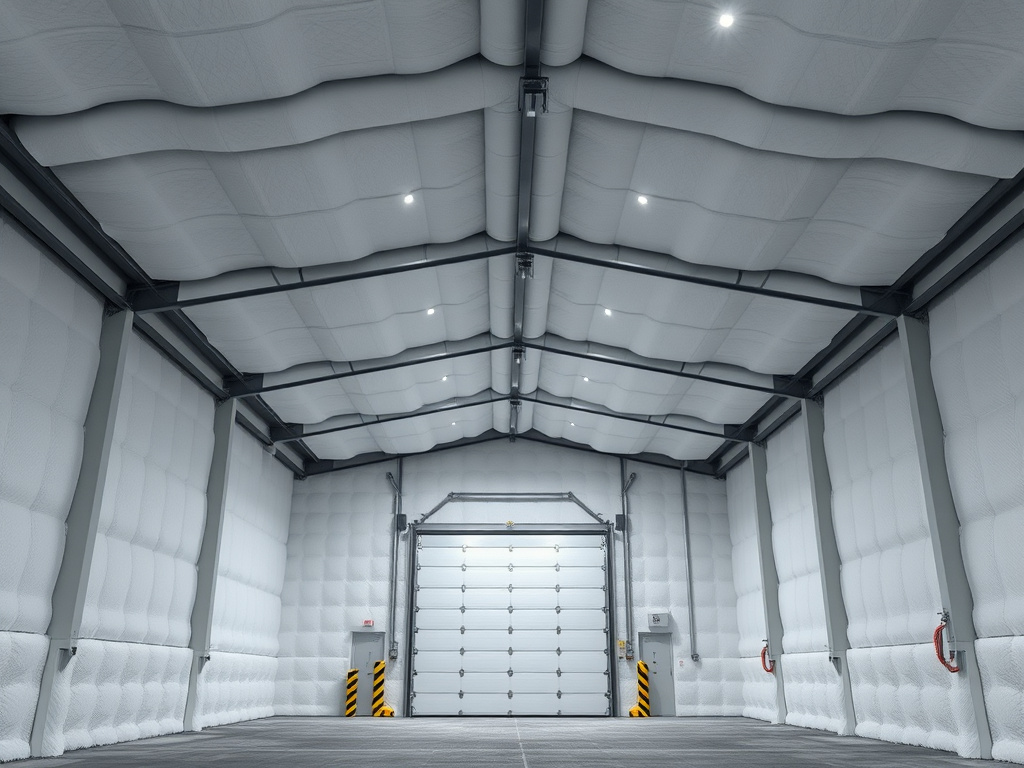
Cold-Chain Facilities
Cold Storage & Temperature-Controlled Facility Insulation — Statewide
A vapor-resistant, thermally continuous envelope for refrigerated and temperature-controlled buildings — built for cold storage warehouses, food and beverage processing, pharmaceutical cold-chain space, and agricultural pre-cooling facilities anywhere in Arizona.
Who This Serves
Cold-chain and temperature-controlled facilities, statewide
This service line covers any building where holding a temperature well below ambient is the point of the structure, not an incidental feature of it: cold storage warehouses and distribution centers, food and beverage processing and packing facilities, pharmaceutical and laboratory cold-chain space, and agricultural pre-cooling and packing structures tied to Arizona's produce and processing economy. We work with facility owners, developers, general contractors, and mechanical/refrigeration contractors on new construction and retrofit projects alike.
- ✓Cold storage warehouses and refrigerated distribution centers
- ✓Food and beverage processing and packing facilities
- ✓Pharmaceutical and laboratory cold-chain space
- ✓Agricultural pre-cooling and packing structures
A Different Envelope
Refrigerated buildings need a fundamentally different envelope
A standard commercial or industrial building envelope is designed to manage heat gain and keep conditioned air in. A refrigerated building has a harder job: it has to hold a sustained, often large temperature differential between the inside and outside air across every wall, ceiling, and penetration, continuously, for the life of the facility. That means three problems a standard envelope doesn't face at the same intensity — continuous vapor control at every penetration and joint, elimination of thermal bridging at framing and structural connections, and prevention of surface condensation anywhere a cold interior surface meets warm, humid air.
Miss any one of those three, and the failure mode is the same: moisture finds the weak point, condenses, and over time soaks insulation, corrodes structure and racking, and can build ice at penetrations and dock doors — all while the refrigeration system works harder to compensate for the lost thermal performance.
0
Seams In Closed-Cell Application
3
Failure Modes It Controls
AZ
Statewide Service
1
Continuous Vapor-Resistant Layer
The Material
Closed-cell spray foam: vapor-resistant and high-R by design
Closed-cell spray foam is the standard material solution for cold-chain envelopes because it does two things at once, continuously, across the entire surface it's applied to: it delivers a high R-value per inch, and its closed-cell structure is inherently vapor-resistant — it doesn't require a separate vapor-barrier sheet layered on top to do that job. Sprayed directly onto walls, ceilings, and irregular framing, it seals continuously around penetrations, conduit, and structural connections instead of stopping at a panel edge.
Batt and rigid board systems, by contrast, depend on every joint, seam, and fastener penetration staying perfectly sealed to control vapor movement — and in a real building, over years of thermal cycling and maintenance access, those joints open. In a refrigerated facility, that's exactly where condensation starts. Closed-cell foam removes the joint as a failure point because there isn't one: the application is monolithic.
Statewide, Not Regional
Arizona's cold-chain economy isn't confined to one metro
Cold storage and temperature-controlled facility work is a genuine statewide commercial niche in Arizona, not a single-city service. Agricultural processing and pre-cooling activity concentrates around the state's produce-growing regions, food and beverage processors and distribution operators sit throughout the Phoenix and Tucson metro corridors and in between, and pharmaceutical and lab cold-chain space follows the state's broader life-sciences and manufacturing growth. A contractor built around one metro simply doesn't see most of this market.
We schedule cold-storage and processing-facility projects wherever the job is — a produce packing operation near Yuma, a food and beverage processor in the Tucson/Pima County corridor, a distribution facility along the Phoenix metro's logistics belt — with the same crew standards and documentation on every one, not a discounted "out of area" version of the service.
Project Logistics
Working around active refrigeration equipment and operations
Very few cold-storage or processing-facility projects happen in an empty building. Most involve active refrigeration equipment, ongoing product handling, and a facility that can't simply shut down for the length of an insulation project. We plan around that from the first site walk: phasing work zone by zone so the rest of the facility keeps operating, scheduling around cooling-system maintenance windows, and coordinating directly with your refrigeration and mechanical contractors so nobody's crew is working blind around the other's equipment.
For new construction, that coordination shifts earlier — sequencing with the refrigeration/mechanical trade so the envelope is closed at the right point in the build without trapping moisture behind a wall before mechanical rough-in is complete. Either way, the project plan gets built around your operation and your trades, not a generic install schedule.
- ✓Phased, zone-by-zone scheduling for partially operating facilities
- ✓Direct coordination with refrigeration and mechanical contractors
- ✓Off-hours and shutdown-window scheduling where a zone needs to come offline
- ✓New-construction sequencing coordinated with mechanical rough-in
Code & Spec
Code and spec basics for insulated cold-storage envelopes
Cold-storage and refrigerated-building envelopes get evaluated against the same jurisdiction-by-jurisdiction adopted code path as any other commercial building in Arizona's home-rule system — most jurisdictions on the 2018 IECC with local amendments, a handful moving to 2021 IECC/IgCC — with particular attention to vapor-retarder continuity and thermal-bridging control at the design and inspection stage, since those are the details that actually determine whether a refrigerated envelope performs. We document application thickness, application area, and detail treatment at penetrations so your design team and code official have what they need for sign-off.
On the incentive side: the federal Section 179D commercial energy-efficiency tax deduction closes to projects breaking ground after June 30, 2026, under the One Big Beautiful Bill Act. Because cold-storage and processing-facility work is frequently a retrofit inside an existing building rather than new construction, 179D eligibility isn't automatic and depends on the specific project scope and timing — worth confirming with a tax professional. Utility-side, TEP's Business Energy Solutions program, APS and SRP commercial programs, and UES commercial programs in the border and northern Arizona territories are all worth checking against a cold-storage retrofit or new build; our Energy Code Compliance & Commercial Energy Audits team can walk through what applies to your project.
| Primary material | Closed-cell spray polyurethane foam |
|---|---|
| Vapor control | Continuous, monolithic — no separate vapor-barrier sheet joints |
| Code path | Jurisdiction-adopted IECC/ASHRAE 90.1, home-rule statewide |
| 179D status | Closes to new construction after 6/30/2026 (OBBBA) — retrofit eligibility varies |
Verify current code adoption and incentive eligibility per jurisdiction and project scope at time of bid.
Related Services
Often paired with cold-storage projects
Many cold-chain buildings are metal or pre-engineered structures, and cold-storage projects frequently sit inside a larger warehouse or distribution facility.
Metal Building & Pre-Engineered Structure Insulation
Condensation and thermal-bridging control for the pre-engineered metal shells many cold-storage and ag processing buildings are built on.
Explore this service →Commercial & Warehouse Building Insulation
Envelope insulation for the broader warehouse and distribution space that often surrounds a cold-storage zone.
Explore this service →FAQ
Cold storage & cold-chain insulation questions
Can you insulate a cold storage or processing building while it's still operating?
+
Yes — most of our cold-chain and processing work happens on active or partially operating facilities. We phase the job into zones, schedule around your refrigeration and mechanical contractors, and work off-hours or in shut-down windows where a zone needs to come offline briefly. Full facility shutdowns are the exception, not the starting assumption.
Why doesn't standard batt or board insulation hold up in a refrigerated building?
+
Batt and rigid board systems depend on tight, continuous installation to control vapor movement, and in practice they rarely stay that way — panel joints open, fasteners create thermal bridges, and any gap becomes a spot where warm, moist air meets a cold surface and condenses. In a refrigerated building that condensation doesn't just waste energy, it soaks insulation, corrodes structure, and can turn into ice buildup at penetrations. Closed-cell spray foam seals continuously across the whole surface, including irregular framing and penetrations, so there's no seam for moisture to find.
Do you work on food and beverage processing facilities, or only cold storage warehouses?
+
Both, plus pharmaceutical and lab cold-chain space and agricultural pre-cooling and packing structures. The building types differ, but the underlying envelope problem is the same: a continuously vapor-resistant, thermally uninterrupted enclosure around a space held well below ambient temperature. We scope each project against its specific temperature zones and mechanical layout, not a one-size template.
How do you handle vapor barrier continuity around dock doors and equipment penetrations?
+
Dock doors, conduit penetrations, and equipment mounts are exactly where conventional systems fail first, because they interrupt a batt or panel run. We treat these as detail points during the walk-through and build the foam application around them specifically, so the vapor-resistant envelope stays continuous at the transitions instead of stopping at the wall and starting again on the other side of a penetration.
Is cold storage and cold-chain insulation work available outside the Phoenix metro?
+
Yes. Arizona's agricultural processing, food distribution, and cold-chain logistics activity isn't concentrated in one metro — it runs statewide, from Yuma-area produce packing to Tucson-area food and beverage processors to distribution facilities in between. We schedule cold-storage and processing-facility projects anywhere in the state, not just the Valley.
More questions? Visit the full FAQ page or read the commercial & industrial spray foam guide.
Request a bid for your cold-storage or processing facility
Tell us your facility type, temperature zones, and whether it's new construction or retrofit, and we'll schedule a walk-through around your operating schedule. Call 844-967-5247 or request a bid online.